Gel saddles, wider tires and suspension seatposts ridden over the same broken asphalt, sorted by what each one absorbs and what it costs you in pedaling.
Road buzz and a pothole edge are two different problems, and most of the parts sold as comfort upgrades only answer one of them. That matters when you are about to spend money on a bike you will ride to the hardware store and back, over the same patched block, twice a week for years. Ride one rough route with each part in turn and the sorting happens quickly. Some things take the sting out of coarse chipseal. Some do nothing until the front wheel drops into a seam. And a couple quietly make the pedaling worse.
Sort the shaking into two kinds before you shop
Buzz is the constant, small, high-frequency vibration that comes off coarse pavement, tar snakes, and old concrete panels. It is what makes your hands go numb at the end of a mile and leaves your shoulders tight. A hit is a single event: a pothole lip, a rolled curb cut, a sunken utility cover. Buzz is fixed by things that flex constantly and at very small amplitudes, mostly air volume in the tires and the cushion under your hands. Hits are fixed by things with real travel, meaning a part that can move a half inch or more. Deciding which one is actually bothering you is the whole exercise.
Air volume does the quiet work
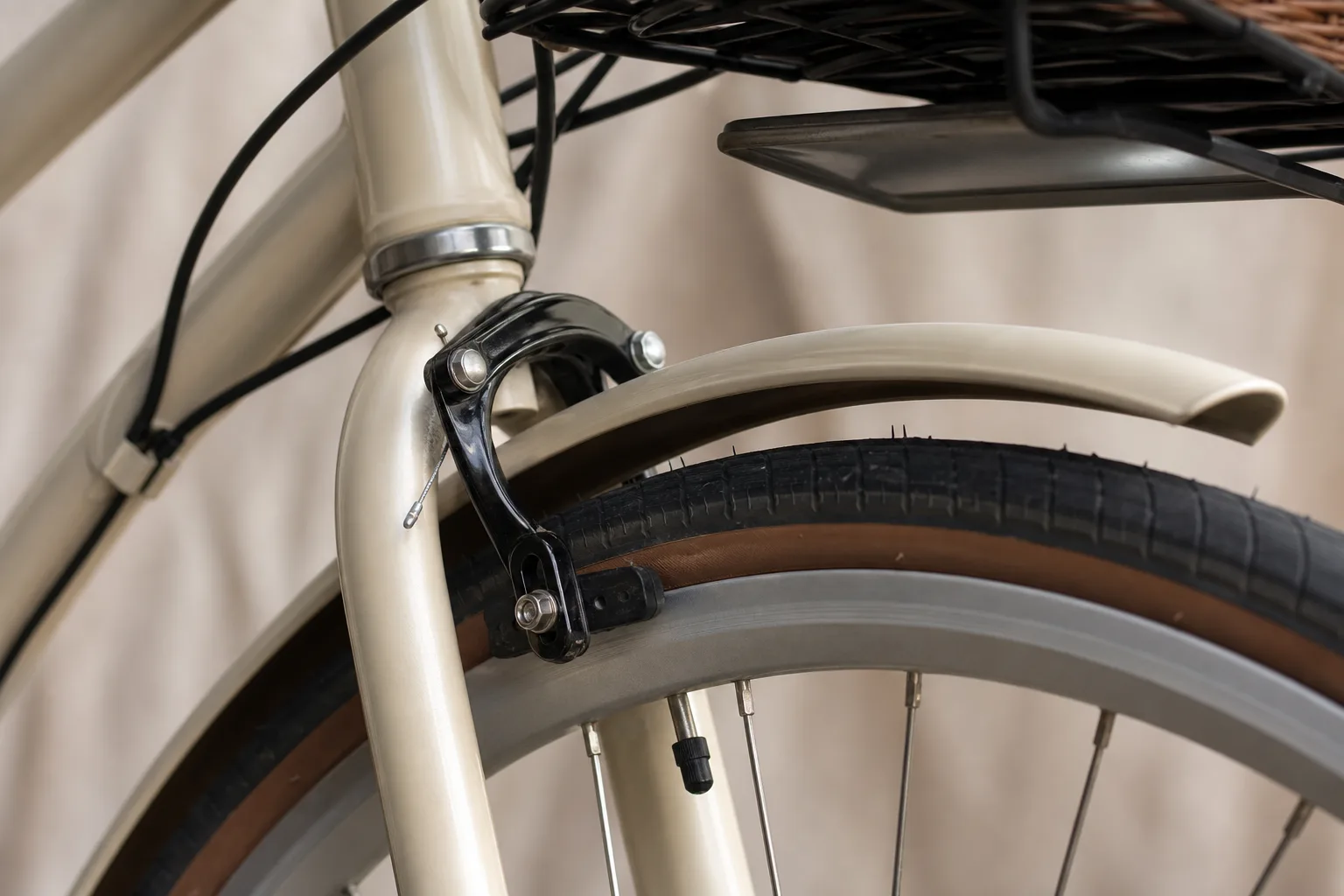
Going from a narrow tire to a wider one at a lower pressure changed more on the rough route than any other single swap, and it changed the part that had been wearing me out: the constant chatter. A wider casing holds more air, and more air at lower pressure means the tire deflects around small edges instead of transmitting them up the fork. The careful check here is not the tire, it is the space around it. Look at the gap between tire and chainstay, tire and fork crown, tire and fender line, with a finger's width to spare for grit and a slightly out-of-true wheel.
Two numbers on the sidewall are worth reading before you buy. The stated width has to agree with the frame clearance you just measured, and the pressure range printed on the casing sets the floor you can safely run. The Consumer Product Safety Commission oversees the safety requirements bicycles sold in the United States have to meet, and tire and rim markings are part of how a shop confirms a combination is being used as intended. Rim internal width matters too, since a very wide tire on a narrow old rim sits in a lightbulb shape that squirms in corners.
A suspension seatpost waits for the big stuff
Over chipseal, the suspension post barely woke up. Over the sunken drain at the bottom of the hill, it did exactly what the tires could not, taking a hit that would otherwise have come straight up the spine and turning it into a soft compression. That is the honest split: a post with an inch of travel ignores buzz and saves you from the events that actually make you flinch and swerve. Check the diameter of your existing post, since suspension posts come in common sizes and shims cover the rest, and check that your frame gives enough insertion depth for a longer post.
Two setup details decide whether it feels good or sloppy. The post sags under your weight, so the saddle sits lower than it did, and you need to raise it by roughly the amount it settles when you sit still. And the spring or elastomer has to suit your weight, because an underdamped post on a light rider does nothing, while a soft one under a heavy rider bobs with every pedal stroke and steals effort on every climb.
Where the gel goes matters more than how much
A thick gel saddle was the least useful change on the rough route and the most tiring on the flat. Deep soft padding lets the sit bones sink until the pressure spreads onto soft tissue, which is where the numbness and the ache come from, and the sinking also makes your effective saddle height wander every time you shift your weight. Gel under your hands is a different story. Padded grips, a thicker grip diameter, and gloves took the numbness out of a route where the bars had been the worst part, and none of it cost anything in pedaling efficiency.
If you are spending in order, tires first, then grips, then the post if the big hits are still what you dread. The saddle is a fit part, not a padding part, and it earns its place by matching the width of your sit bones and the angle your hips actually sit at.